Projects
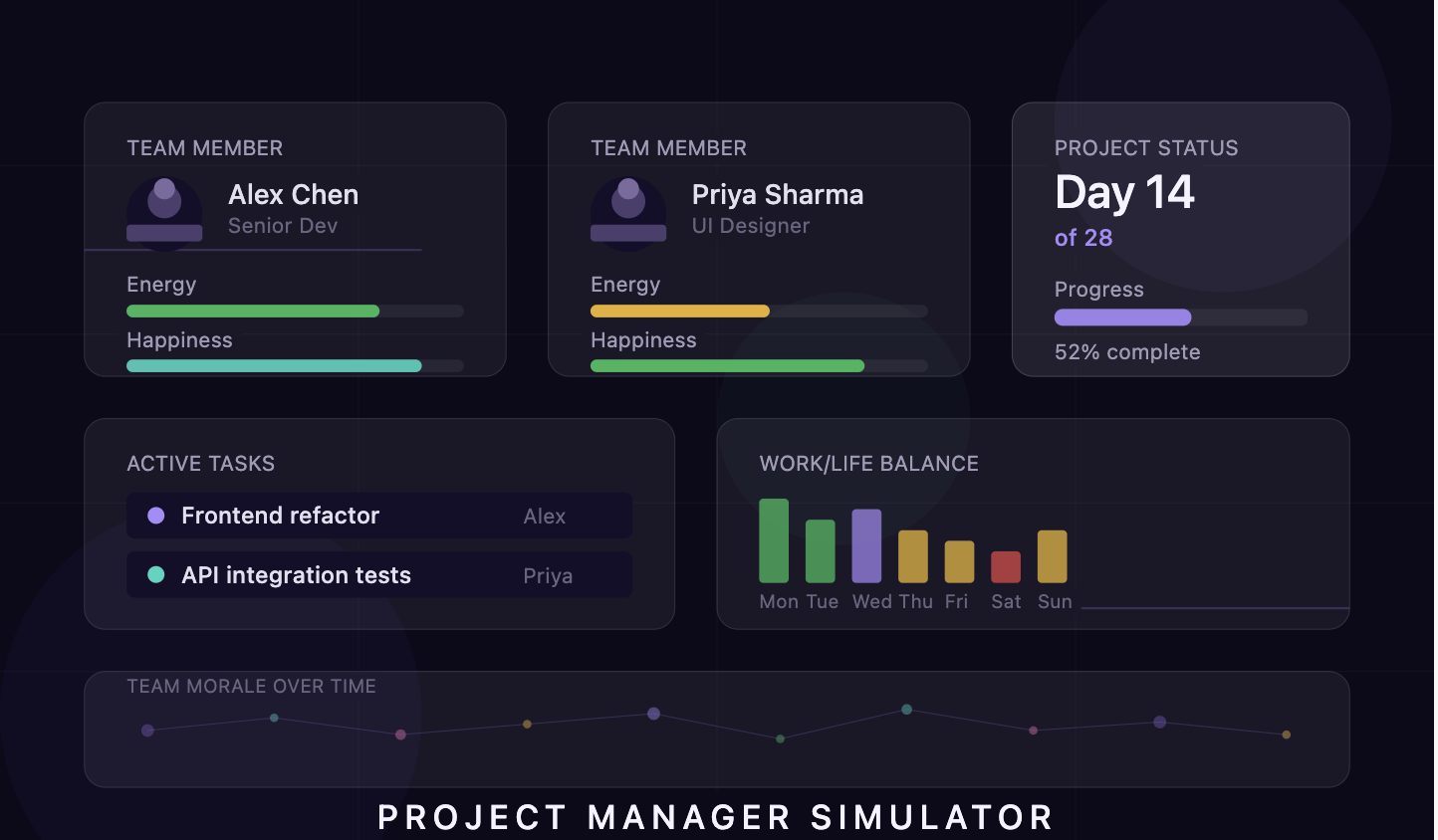
Project Management Simulator
The Project Manager Simulator is a browser-based educational game where players manage a software development team across a 28-day project lifecycle, balancing task delivery against team wellbeing, interpersonal dynamics, and energy management. Players select a team of four from ten NPCs with unique traits and relationships, then navigate daily decisions about task assignment, rest allocation, and unexpected events while keeping energy, happiness, and project progress in check. The game features a polymorphic decision system driven by JSON content, six distinct mini-games tied to a bug-tracking mechanic, and a real-time chemistry analysis system that turns team selection into a genuine optimisation problem.
My contributions sat at the intersection of design and systems thinking. I built the Work/Life Balance system with a five-tier colour-coded gradient that ties into energy recovery and rest efficiency calculations, creating the feedback loop between energy, happiness, and productivity that makes the simulation feel meaningfully interconnected rather than a set of independent sliders. I designed the entire Midnight Purple glassmorphism UI theme across 11 modular CSS files, including the card-based interface and fade toggle interactions that define the game's visual identity. I also took ownership of stabilising the CI/CD test suite, debugging and fixing failures across the full stack to get all 427 tests passing at 97% coverage.
This project changed how I think about building software. Working with Django polymorphic models and a JSON-driven content pipeline pushed me beyond standard CRUD development into genuine domain modelling, where small parameter changes cascade through interconnected systems simultaneously. That is fundamentally the same challenge as designing any simulation, recommendation engine, or data-driven product. Designing the UI theme from scratch gave me practical UI/UX experience that my other projects lack, and taught me that how a system communicates its state visually is just as important as the logic underneath. Most significantly, this was my largest collaborative experience to date: eight people, a CI pipeline, weekly standups, and a deployed product. Navigating role changes, coverage gaps, and coordination across a team this size is closer to how real engineering teams operate than anything else on my CV, and it made me a significantly more resilient and adaptable collaborator.
Recipify - Community Recipe Platform
Recipify is a full-stack community recipe platform built with Django, where users discover, create, and share recipes based on available ingredients, dietary preferences, and browsing behaviour. The system recommends dishes through intelligent filtering and personalised suggestions, tackling the everyday problem of food waste and meal-planning fatigue.
Building Recipify sharpened skills that cut across software engineering, data science, and applied AI. On the engineering side, working with Django's MTV architecture, ORM, and built-in authentication framework gave me production-level full-stack experience, designing relational schemas for complex many-to-many relationships (followers, friend circles, recipe tags), implementing role-based access control and content moderation workflows, and delivering a responsive, mobile-friendly frontend with Bootstrap. This was a significant step up from my earlier Flask projects, moving from microframework prototyping into opinionated framework-level development: the kind most production teams actually use. On the data and intelligence side, the recommendation engine required thinking like a data scientist: collecting user signals, weighting and ranking them, and surfacing personalised results. Designing a flexible tagging and filtering system that scales as recipes grow and balancing rule-based recommendation logic against user-preference weighting gave me hands-on experience with the data pipeline behind personalisation, and a clear understanding of where rule-based approaches end and where machine learning techniques like collaborative filtering would take over.
The project was developed collaboratively as a team, with responsibilities divided across backend logic, frontend design, database schema, and feature integration. We coordinated through Git, regular standups, and shared documentation — Agile-style delivery under real deadlines. This was my third shipped team project alongside the London Air Quality Tracker and Wild Web, but the most product-shaped: we deliberately prioritised a cohesive, polished user experience over feature breadth, making the core flows — search, discover, cook — genuinely satisfying rather than ticking boxes. Recipify is the bridge between building ML pipelines and building products people actually use. Recipify demonstrates I can think about how recommendations, personalisation, and intelligent filtering land in the hands of real users, and ship that as a team.

Speech Emotion Recognition Model
in progress
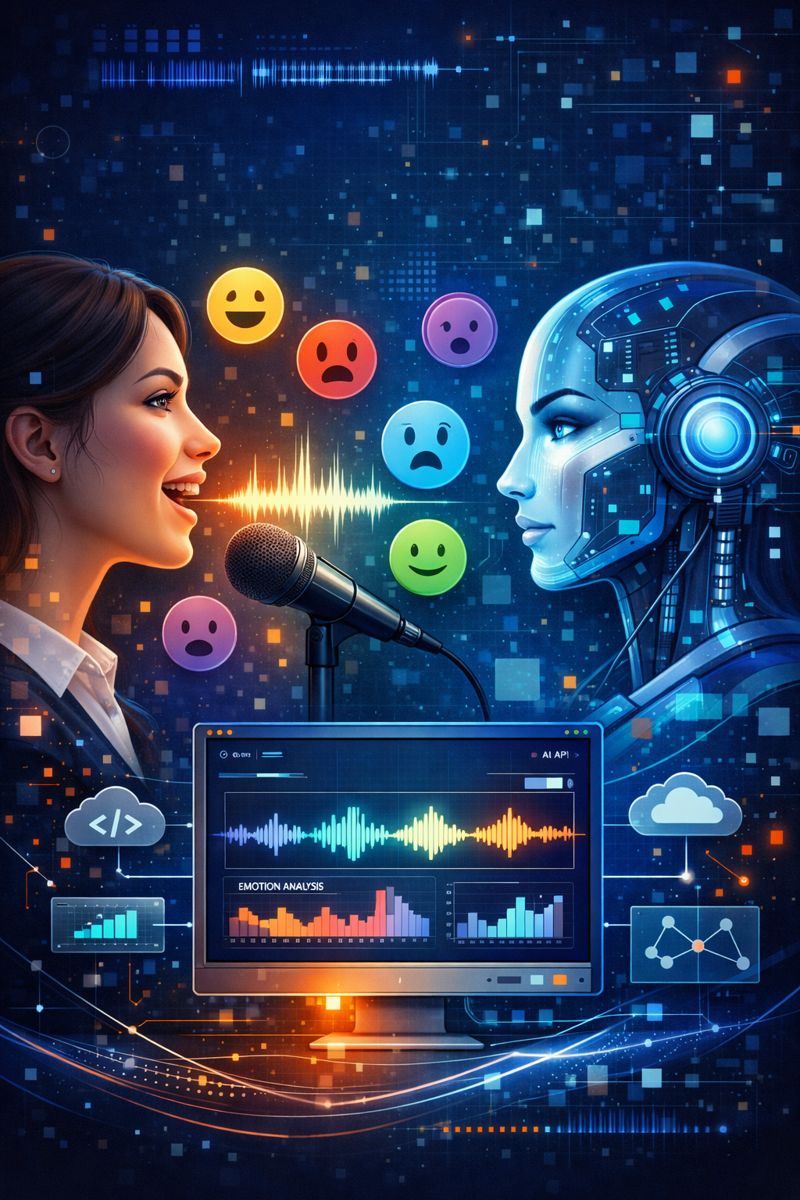
This project developed a machine learning system for speech emotion recognition (SER). SER is challenging due to the subjective nature of emotions, speaker variability, and real-world noise. The project aimed to design and implement a deep learning pipeline to process speech and predict emotional categories, enhancing audio-based machine learning. A core challenge is interpreting emotions from speech, a continuous signal with variable length, pitch, and style. Overlapping emotional expressions further complicate classification. This project explores deep learning models for extracting meaningful representations for emotion classification. The objective was to build a supervised learning model that takes audio files as input and predicts emotion labels, focusing on model development, training, and evaluation. The dataset comprised labeled speech audio files in a structured format, with folders for each emotion class. Key challenges included audio duration differences, noise, speaker variability, and class imbalance. The project was implemented in Python using PyTorch, Librosa for audio processing, NumPy for numerical operations, and Torchvision for leveraging pretrained CNNs. Scikit-learn was used for dataset splitting and evaluation. The system follows a pipeline: audio files are preprocessed, converted into tensors, passed through a neural network, and mapped to emotion predictions. Preprocessing involved normalizing the signal and padding/truncating to ensure consistent input length. A CNN based on a pretrained VGG16 model was used, leveraging transfer learning. The model was trained using cross-entropy loss and gradient-based optimization. Design decisions involved trade-offs between CNNs for feature extraction versus modeling temporal dependencies, fixed audio length for training feasibility versus potential information loss, and pretrained VGG for improved learning versus increased cost. Model performance was evaluated on a test set using accuracy and error analysis, revealing confusion between similar emotions. Challenges included handling noisy data, tuning parameters, and managing overfitting. The project demonstrated the subjective nature of emotion recognition. The codebase was modular, separating data handling, model definition, and training logic. A custom dataset class was implemented, and the training pipeline was designed to be extensible. Ethical considerations were addressed, acknowledging privacy risks and treating the model as a research exercise. Key learnings included understanding audio preprocessing, the advantages of transfer learning, and the limitations of CNNs for sequential data. Future improvements include transformer-based models, spectrogram representations, data augmentation, cross-dataset generalization, and continuous emotion dimensions, as well as multimodal emotion recognition. Overall, this project demonstrates skills in machine learning, deep learning, audio processing, and software engineering, showcasing the ability to work with complex data, reason about trade-offs, and evaluate model performance. The techniques are relevant to roles in AI, data science, machine learning engineering, and research.
LLM Based Search Engine
in progress
This project delivers relevant current affairs and auto-generated quizzes using large language models (LLMs), semantic embeddings, and news data. It retrieves, filters, and ranks news articles based on a user's topic, recommends related content, and generates factual quiz questions to enhance understanding.
Addressing the challenge of navigating vast real-time news, this project combines information retrieval with semantic filtering and LLM-based content generation to ensure relevance, coherence, and engagement. It aims to retrieve relevant articles, reduce noise, surface diverse perspectives, and transform passive reading into active learning.
The primary objective was to design a modular pipeline demonstrating skills in NLP, semantic similarity, system design, and LLM integration. This functional prototype emphasizes data flow, transparency, and extensibility.
The application captures user queries via CLI, web form, or API, applying input validation for robustness. It collects data using news APIs or RSS feeds, storing articles with metadata.
The filtering and ranking module uses semantic embeddings to rank articles by relevance, retaining only the top-N articles. A recommendation engine then suggests related content, promoting broader understanding.
The quiz generation module summarizes content and uses an LLM to generate multiple-choice, true/false, or short-answer questions, structured in JSON to test factual understanding.
The system follows a linear pipeline: query ingestion, data collection, semantic filtering, recommendation, and content generation. Modules are decoupled for independent testing and enhancement.
Technical trade-offs include balancing relevance with computational cost, limiting results to improve quality, and validating LLM-generated quizzes. These reflect real-world engineering considerations.
Challenges included handling varied article structures and ensuring semantic similarity aligns with user intent. Ensuring factual correctness in LLM-generated questions also proved difficult.
Key learnings include practical experience with semantic search, LLM integration, and modular system design. The project reinforces the distinction between information retrieval and understanding.
Future improvements include adding source diversity constraints, implementing confidence scoring for quizzes, supporting multilingual content, caching embeddings, and deploying the system as a web application. Additional extensions could involve difficulty-adjusted quizzes and longitudinal knowledge tracking.
Overall, this project demonstrates competence in NLP, semantic similarity, LLM integration, and system design. It showcases the ability to manage trade-offs and build learning-oriented applications using modern AI techniques, relevant to roles in data science, applied AI, machine learning engineering, and software engineering.

London Air Quality Tracker
Wild Web - Predator and Prey Simulation
Sunblock Saga

The Orchid Project
Production Management System
for Vinod Rice Mill Pvt Ltd
This project involved developing a full-stack, role-based web application to optimize order processing, internal coordination, and client communication for Vinod Rice Mill Pvt Ltd, a manufacturing business. The system replaced a fragmented manual workflow that relied on multiple applications and direct communication for tracking production, quality control, and shipment status. The project was driven by direct client engagement and a needs analysis that revealed operational inefficiencies stemming from scattered information, delayed updates, and potential for human error. The primary objective was to create a centralized software solution that enhances visibility, accountability, and data consistency, while ensuring ease of adoption within the existing business environment. The core problem addressed was the absence of a unified system for managing order lifecycles across departments with varying responsibilities and access privileges. The system needed to provide role-specific data views while maintaining security, real-time updates, and traceability. The application was built as a role-based web platform using Python, Flask, SQL, HTML, and CSS. Users are authenticated and authorized upon login, then directed to role-specific dashboards displaying relevant functionalities. This access control model ensures data privacy and operational clarity. Administrators possess full system control, including employee management, order oversight, and system configuration. The administrator dashboard facilitates employee account management, detail viewing, employee removal, and order progress monitoring, supporting quality assurance and accountability. Employees are assigned functional roles (e.g., production, finance, shipment), each with a dedicated interface for updating order status within their department. This modular design minimizes cognitive load and prevents unauthorized data modification. Customers interact through a dedicated interface to place orders, view details, track history, and receive real-time updates. This structured communication enhances transparency and customer trust. Orders follow a defined lifecycle, with each update persistently recorded for auditability and analysis. This structured record-keeping enables bottleneck identification, error reduction, and performance evaluation. The system supports order completion, payment tracking, and historical reporting. Technically, the application uses Flask routes for authentication, authorization, and business logic. SQL ensures persistent data storage and consistency. HTML templates and CSS create a clean, role-appropriate interface with shared layout components for maintainability. A key design consideration was phased deployment feasibility, allowing the client to pilot the software, evaluate its effectiveness, and transition gradually, minimizing operational risk and maximizing user acceptance. This approach reflects realistic change-management constraints in small and medium enterprises. The project emphasizes separation of concerns, with clear divisions between authentication, role validation, order management, and UI rendering. Templates are designed for specific user journeys, enhancing clarity and reducing coupling. Development challenges included designing intuitive role-based navigation, preventing unauthorized data access, and ensuring synchronized updates across user views, requiring careful session management, access controls, and database consistency. Key learnings included translating business requirements into software architecture, implementing role-based access control, designing multi-user workflows, and building systems that support real operational processes. The project also enhanced skills in client communication, iterative design, and balancing technical solutions with organizational realities. Future improvements include adding analytics dashboards, automated notifications, finer-grained permissions, and scalability for additional product lines or facilities, potentially extending the system with mobile interfaces or API integrations. Overall, this project demonstrates applied software engineering skills in building secure, role-based, data-driven web applications with real business impact, showcasing the ability to analyze real-world problems, design structured solutions, and implement systems that improve efficiency, accountability, and customer experience.